
- July 27, 2026
- By: Riddhi Pharma Machinery Ltd.
- No Comments
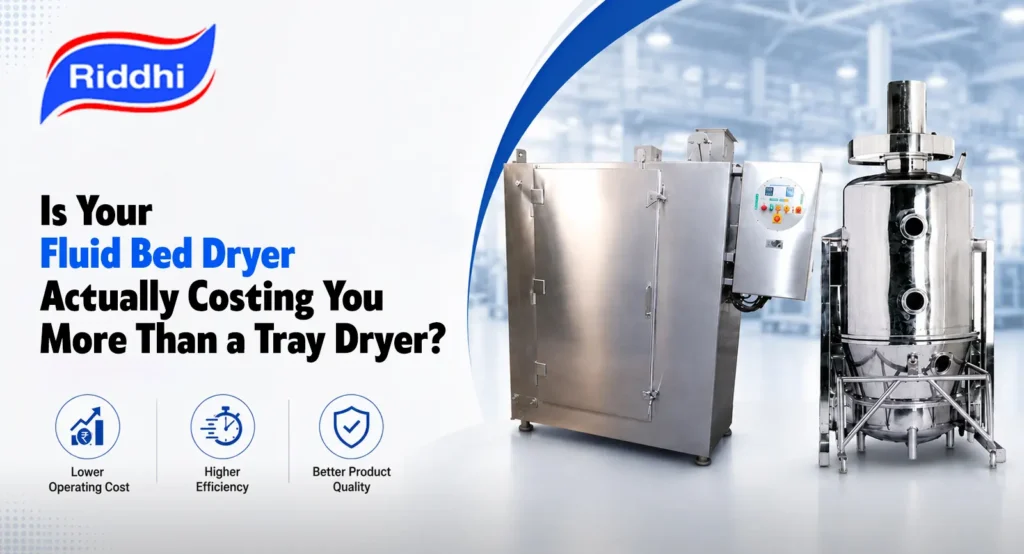
Is Your Fluid Bed Dryer Actually Costing You More Than a Tray Dryer?
Quick Summary: The Fluid Bed Dryer versus tray dryer debate comes up in almost every pharma plant at some point, usually when someone looks at the electricity bill or a slow batch and starts questioning whether they have the right machine. This article breaks down the cost comparison, what each machine actually delivers on the floor, and how to know which one makes sense for your specific production situation.
Table of Contents:
Why This Question Comes Up More Than It Should?
Someone in a plant meeting looks at the power consumption figures, compares the purchase cost of a Fluid Bed Dryer against a tray dryer, and asks the question, ” Are we spending more than we need to on drying?
On paper, tray dryers are simpler, cheaper to buy, and cheaper to run per hour. The dryer costs more upfront and draws more power during operation. If you stop the comparison there, the Tray Dryer wins on cost every time.
But that comparison leaves out most of what actually matters on a production floor: drying time, batch consistency, labour involvement, floor space, and what happens to your output quality when drying is uneven. Once those go into the calculation, the picture changes significantly.
What a Fluid Bed Dryer Does Differently?
The Fluidisation Principle: Why It Matters
In a tray dryer, material is in layers on trays. Hot air passes over the surface. The material dries from the outside in, and the layers closest to the air source dry faster than the ones further away. That unevenness is built into the process; it is not a maintenance problem or an operator error, it is just how the design works.
A Fluid Bed Dryer works on a completely different principle. Hot filtered air is pushed up from below through an air distributor plate and a Dutch weave sieve into the product container. The air velocity is high enough to lift and suspend the particles, and they start behaving almost like a boiling liquid. Every particle, not just the ones on the surface, is surrounded by moving hot air at the same time.
The result is that each particle dries at roughly the same rate. No wet layers are hiding underneath dry ones. The drying is genuinely uniform across the batch, not just on the parts you can see.
What That Means for Drying Time?
Pharmaceutical granules or crystals with free moisture of about 20 to 25 percent can be dried in a Fluid Bed Dryer in approximately 30 to 40 minutes at around 75°C. Crystalline materials with as much as 40 percent moisture can be handled in 35 to 45 minutes.
A tray dryer doing the same work takes significantly longer and requires someone to physically turn or redistribute the trays at intervals to manage the uneven drying. On a production floor where batch turnaround time matters, that time difference adds up across a week or a month of production.
The Cost Comparison: Beyond Just Energy Bills
Labour Is the Cost Nobody Talks About Enough
Riddhi Pharma’s own product description makes this point directly: tray dryers involve high labour input. Someone has to load the trays, monitor the drying manually, check the moisture content on different trays at different stages, and adjust or redistribute material as needed. For a large tray dryer with 96 or 192 trays, that is a meaningful labour commitment per batch.
A Fluid Bed Dryer running the same material largely manages the drying process through its air flow and temperature control system. The operator monitors rather than manually manages the drying. Less time, less manual handling, less risk of operator-to-operator variation affecting the batch outcome.
Floor Space Is a Bigger Factor Than Most Plants Calculate
Tray dryers occupy a large space, as stated directly in Riddhi Pharma’s comparison of the two technologies. For a plant where floor space translates to production capacity, a large tray dryer setup takes up room that could be doing something else.
A Fluid Bed Dryer is a compact unit. The same batch that would require a large bank of tray dryer shelves runs in a single, self-contained unit that takes up considerably less floor footprint. For plants that are already pressed for space or looking to add processing lines without expanding the building, this matters more than the electricity comparison.
Batch Consistency Has a Cost Too
When a tray dryer produces a batch where some material is over-dried and some is under-dried, the consequences are not just quality-related. Under-dried material that passes through undetected causes problems at tablet compression. Over-dried material can affect granule flowability. Either way, you are dealing with rework, investigation time, or rejection, all of which cost money that does not show up in the energy bill comparison.
Consistent drying from a Fluid Bed Dryer reduces the frequency of these events. The per-batch cost of prevention is generally much lower than the per-event cost of dealing with a drying
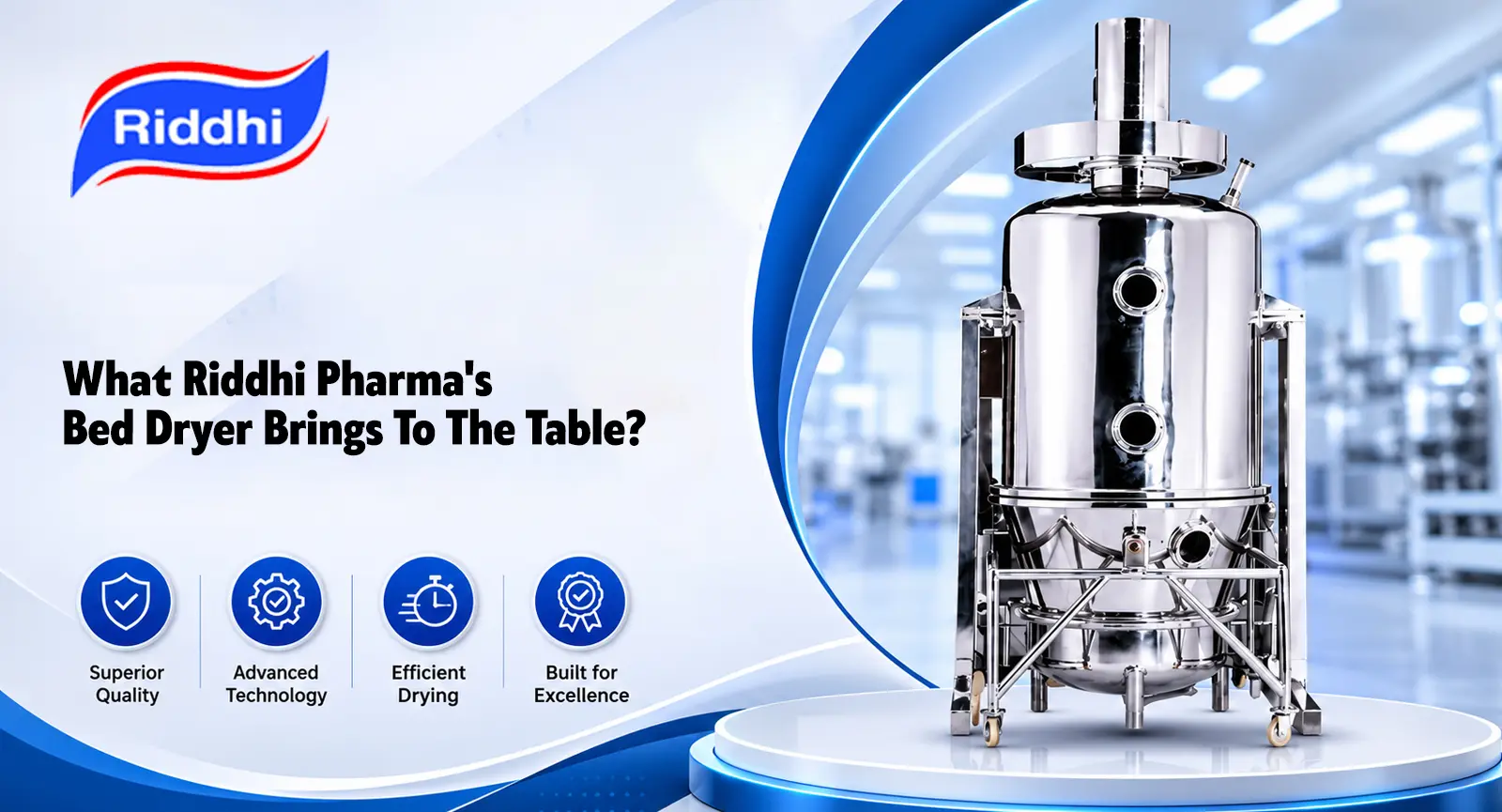
What Riddhi Pharma’s Bed Dryer Brings to the Table?
Batch Sizes That Cover the Full Production Range
Riddhi Pharma manufactures batch-wise Fluid Bed Dryers in capacities of 30, 60, 120, 200, 250, and 500 kg, along with a lab model for process development. That range covers everything from small development batches through to full production scale without needing to change machine type as volume grows.
Multiple Heating Options
The machines can be supplied with electric heating, steam heating, hot water circulation, or gas heating, depending on what the plant’s utility infrastructure supports. Electrically heated models raise air temperature from around 30°C to 75°C. Steam-operated models work at similar temperature ranges and are generally more economical for larger models. Riddhi Pharma incorporates steam heating as standard for models larger than RDFD-60 for this reason.
GMP Design for Pharmaceutical Use
The GMP models have all contact parts in SS304 or SS316 material, isolated panel boards, and designs that eliminate dead zones where product can accumulate and cross-contaminate. The latest design improvements make these units genuinely suitable for pharmaceutical GMP environments rather than just adapted from industrial designs.
The control panel includes a digital timer, digital temperature indicator cum controller for inlet temperature, and the filtration system uses PP filter bags for exhaust air with single-stage 20-micron filtration as standard, with multi-stage filtration available.
How to Decide Which One Your Plant Needs?
The honest answer is that the right choice depends on your specific product, your batch schedule, your floor space, and your labour costs. There is no universal answer.
Ask yourself these questions before deciding:
- Does your material tolerate agitation during drying, or does it need to sit still?
- How many batches per shift are you running, and how much does the turnaround time between batches affect your output?
- How much floor space can you actually allocate to drying equipment?
- What is your current labour cost per batch for tray drying operations?
- Does your product contain solvents or require flameproof equipment?
If your answers point toward high batch frequency, labour cost pressure, space constraints, and moisture-sensitive material that fluidises well, a Fluid Bed Dryer is probably the right call. If your material is fragile, your batches are small and infrequent, and you have the space and labour to manage tray drying, a tray dryer may suit you better.
Conclusion
The Fluid Bed Dryer costs more to buy and draws more power per hour than a tray dryer. Those two facts are true, and they are often the starting point for the comparison. But drying time, labour per batch, floor space, and the cost of inconsistent drying downstream are also costs, and they tend to favour the bed dryer significantly for most pharmaceutical and fine chemical applications running regular batch schedules. Riddhi Pharma Machinery Ltd has been manufacturing pharmaceutical drying equipment since 1990 and has supplied over 900 machines globally.
FAQs
How long does a Fluid Bed Dryer actually take to dry pharmaceutical granules compared to a tray dryer?
Pharmaceutical granules with 20 to 25 percent free moisture dry in approximately 30 to 40 minutes in Riddhi Pharma’s Fluid Bed Dryer at around 75°C. Crystalline materials with up to 40 percent moisture dry in 35 to 45 minutes. Tray dryers processing the same materials take considerably longer and require manual redistribution of trays during the drying cycle to manage uneven moisture removal.
Can Riddhi Pharma's Fluid Bed Dryer handle products containing solvents or inflammable substances?
Yes, but the configuration matters. For products with solvents or inflammable substances, Riddhi Pharma supplies the dryer in a steam-operated configuration with a flameproof motor. The standard electric models are not appropriate for solvent-bearing materials. This is something to specify clearly when ordering, rather than assuming the standard model covers solvent applications.
What filtration system does Riddhi Pharma's Fluid Bed Dryer use for exhaust air?
The standard configuration uses single-stage 20-micron PP cloth filter bags for exhaust air. Multi-stage filtration is available on demand for applications where tighter particle containment is required, for potent compounds or highly regulated products, where any escape of particulates into the exhaust air is a compliance concern. This should be discussed with Riddhi Pharma at the specification stage rather than retrofitted later.