
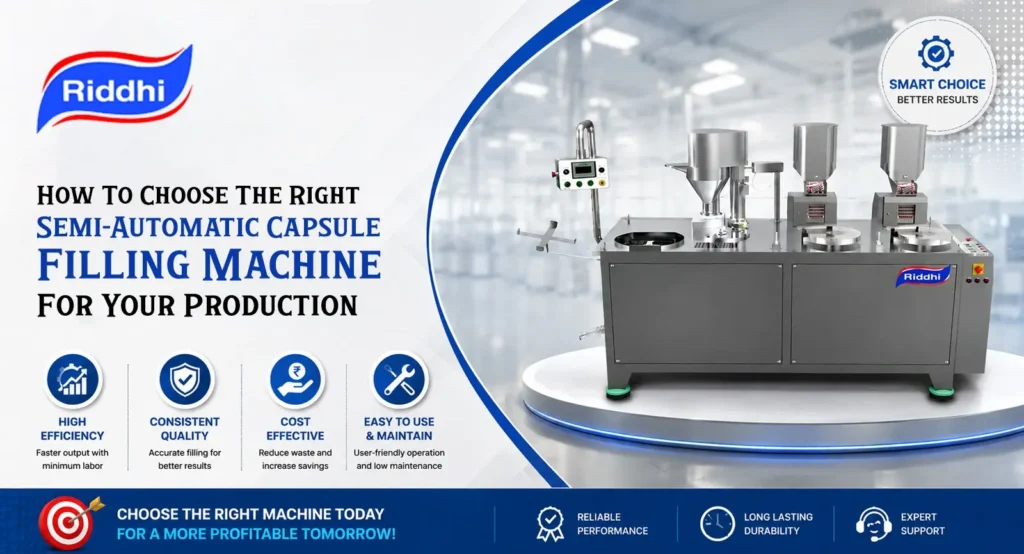
How to Choose the Right Semi-Automatic Capsule Filling Machine for Your Production
Introduction
A pharmaceutical capsule filling machine or nutraceutical business scaling up production eventually hits the same wall: manual capsule filling stops being fast enough, but a fully automatic line costs more than the business can justify yet. A semi-automatic capsule filling machine is placed in that gap deliberately, and understanding what it does, rather than just what it’s called, makes the difference between a good purchase and an expensive mismatch.
What a Semi-Automatic Capsule Filling Machine Does
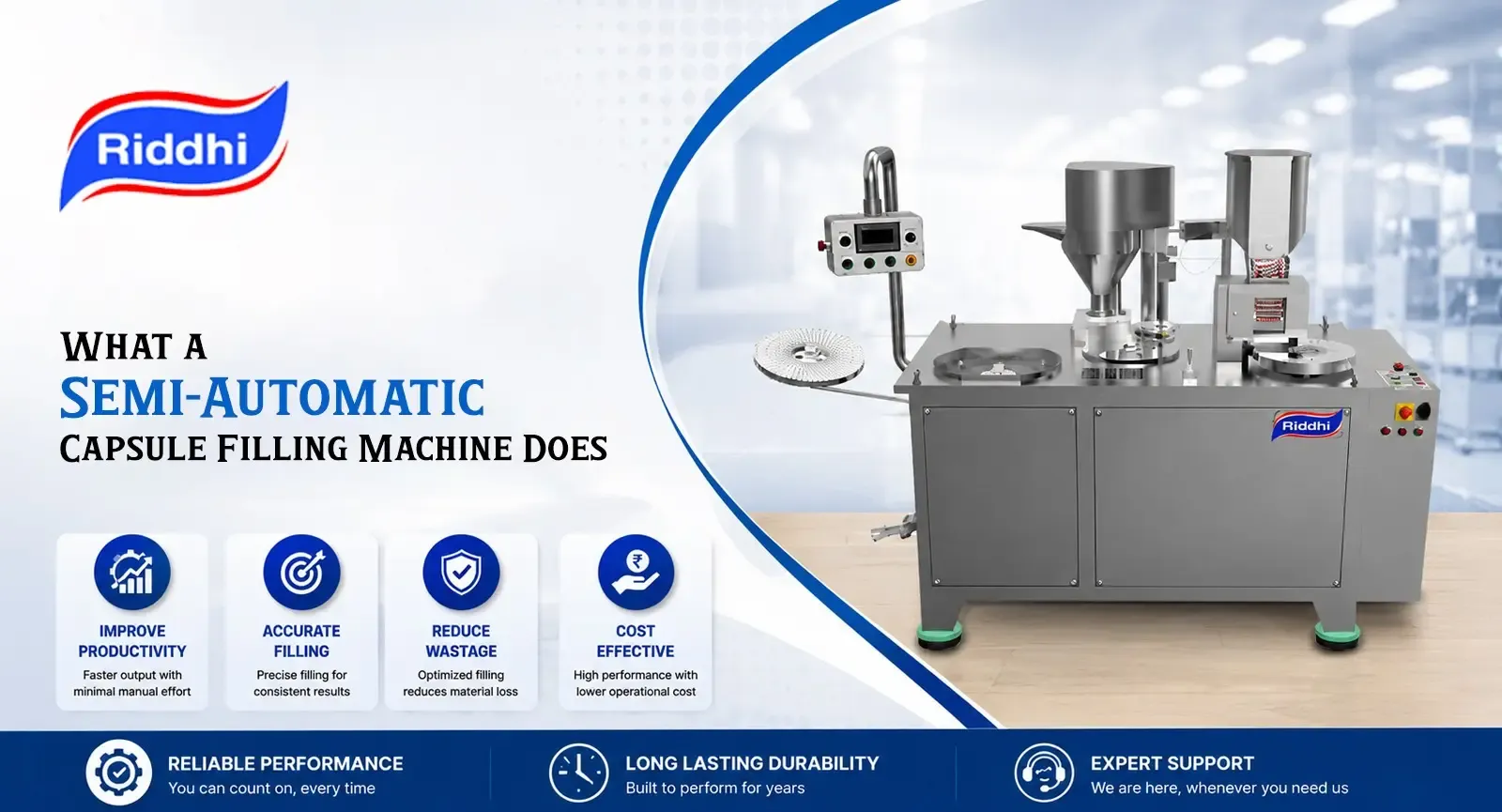
At its core, this equipment automates the parts of capsule filling that are hardest to do consistently by hand, while still relying on an operator for setup and monitoring.
- Capsule orientation. Empty capsules load into the machine and get oriented correctly before anything gets dispensed into them.
- Powder, granule, or pellet dosing. An auger, essentially a rotating screw mechanism, measures and dispenses the fill material into the capsule body at a controlled rate.
- Empty capsule ejection. The machine checks whether each capsule actually got filled, and uses air force to eject any that came through empty due to a mechanical fault.
- Damaged capsule sorting. A separate sorter catches capsules that came through diametrically warped, so only properly proportioned capsules move forward to packaging.
Neither the ejector nor the sorter exists in a purely manual capsule filling process, which is a big part of why semi-automatic capsule filling machine equipment closes such a meaningful accuracy gap over hand filling.
What Affects Capsule Filling Accuracy
Accuracy isn’t a single spec; it’s the result of several mechanical details working together. Auger design matters considerably, since a four-speed auger allows the machine to adjust for different powder densities and pellet types rather than forcing every formulation through the same fixed dosing speed. A loading ring that fits precisely to your capsule size reduces misalignment during orientation, which directly affects fill consistency.
The empty capsule ejector and damaged capsule sorter both contribute here too, not by improving the fill itself, but by catching the batch’s failures before they reach packaging. A semi-automatic capsule filling machine without these checks can produce the same dosing accuracy on paper while still shipping a higher percentage of genuinely faulty capsules, simply because nothing downstream is catching them.
Features to Check Before You Buy
A few features consistently separate reliable capsule filling equipment from equipment that looks similar on a spec sheet but underperforms in daily use:
- GMP-compliant construction. Look for stainless steel contact parts, typically SS 304 or SS 316, since these directly affect cleanability and regulatory compliance in pharmaceutical capsule filling machine settings.
- Memory for settings, PLC control. The machine stores the filling parameters for certain products, so the machine doesn’t need to be reset from scratch every time you switch between formulations.
- Adapts parts for 2 capsule sizes. Some companies that produce several different product lines need this kind of flexibility, so identify which capsule sizes are natively supported by a semi-automatic capsule filling machine and which require change parts to be swapped out.
- Empty capsule ejection and damaged capsule sorting. These aren’t optional extras. Without them, quality control shifts almost entirely onto manual inspection after filling, which slows production and increases labor cost.
- Realistic output rate under your actual formulation. Published output figures assume optimal conditions. Ask specifically how output changes with your product’s density and your operator’s experience level.
Matching the Machine to Your Production Volume
Output on a semi-automatic capsule filling machine isn’t one fixed number you can just look up. It depends on your formulation and how skilled your operator is, which means matching volume to the right machine takes a bit more thought than just grabbing whichever one has the highest output rating.
- Running smaller batches that change often? You’ll get more value from a machine with flexible PLC-saved settings and parts that swap out quickly than one that just promises a higher ceiling on output.
- Running long, steady production cycles? Then stable, high-volume dosing accuracy over hours of continuous runs matters more than anything else.
- Testing out multiple products? Pay attention to how easily the machine switches between capsule sizes; that day-to-day flexibility often ends up mattering more than peak output ever will.
- Sticking to one main product line? In that case, it makes sense to lean into maximizing throughput specifically for that formulation.
Get this match wrong, and you end up in one of two expensive spots: paying for capacity you’ll never actually use, or buying something underpowered that turns into your bottleneck within a year of scaling up.
Conclusion
A semi-automatic capsule filling machine is about closing the gap between manual limitations and full automation cost, without settling for either extreme. Getting the fit right depends less on flashy specs and more on how the machine handles your formulation and volume. Riddhi Pharma Machinery Ltd. has built capsule filling equipment around exactly that kind of practical, production-focused decision-making since the 1990s, which is why so many pharmaceutical businesses return for their next line expansion.
FAQs

Riddhi Pharma Machinery Ltd.
Riddhi Pharma Machinery Ltd. has expertise in manufacturing pharmaceutical machinery. We have 28 years of experience in providing high-quality machinery solutions.