
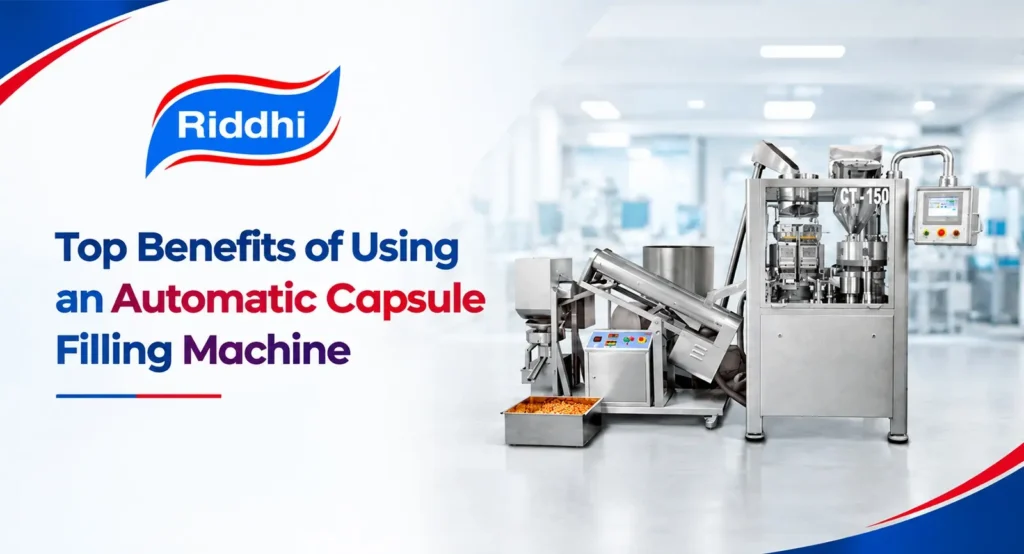
Top Benefits of Using an Automatic Capsule Filling Machine

Automatic Capsule Filling Machine, Top Benefits of Using an Automatic Capsule Filling Machine

Top Benefits of Using an Automatic Capsule Filling Machine

Quick Summary: An automatic capsule filling machine handles the entire capsule filling cycle- separation, filling, and joining- without manual intervention at each step, offering significant gains in speed, consistency, and hygiene compared to manual and semi-automatic alternatives. This Blog covers the specific benefits that make automatic filling worth the investment, how it compares to manual and semi-automatic capsule filling machine options, and what pharmaceutical manufacturers should weigh before upgrading.

Table of Contents:

Introduction

There’s a moment almost every capsule manufacturer hits eventually: production is picking up, orders are coming in faster, and the filling line just can’t keep pace anymore. Operators are working longer shifts, fill weights are drifting slightly from one batch to the next, and someone on the QA team keeps flagging inconsistencies that used to be rare. No one is doing anything wrong. Manual and semi-automatic capsule filling machine were never built to handle this much volume.

This is usually the point where an automatic capsule filling machine is useful. Instead of relying on an operator to orient, fill, and close each capsule by hand, the machine handles the entire cycle on its own, and it does it the same way, capsule after capsule, whether it’s the first one of the shift or the fiftieth thousand. That kind of repeatability is hard to overstate. A slight variation in fill weight might sound minor, but at scale it’s the difference between a batch that clears QA without a second look and one that gets pulled for testing.

What makes an automatic capsule filling machine worth it isn’t just the speed, though the speed is significant. It’s what that speed comes paired with: tighter dosing accuracy, less powder lost to spillage, and a production record you can hand to an auditor without hesitation. For a manufacturer trying to grow past the ceiling that manual filling puts on output, this is usually where the shift happens.

Manual, Semi-Automatic, or Automatic: Where Each One Fits

There’s no single best machine here, only the one that fits your batch size and how often you switch formulations. Manual capsule filling machines are the right call for R&D work, compounding pharmacies, and trial batches. An experienced operator working a 100-hole plate can fill somewhere between 2,000 and 4,000 capsules an hour, and for small runs that’s fine.

Semi-automatic capsule filling machines are in the middle. They still need someone at the controls for each cycle, but output climbs to roughly 10,000 to 30,000 capsules an hour, which is where a lot of growing supplement and pharma brands land once manual filling starts consuming too much time.

Automatic capsule filling machines are built for volume. Depending on the model, they run anywhere from around 25,000 capsules an hour on compact units to well over 400,000 an hour on high-speed rotary systems. That’s not a typo; it’s genuinely that wide a range.

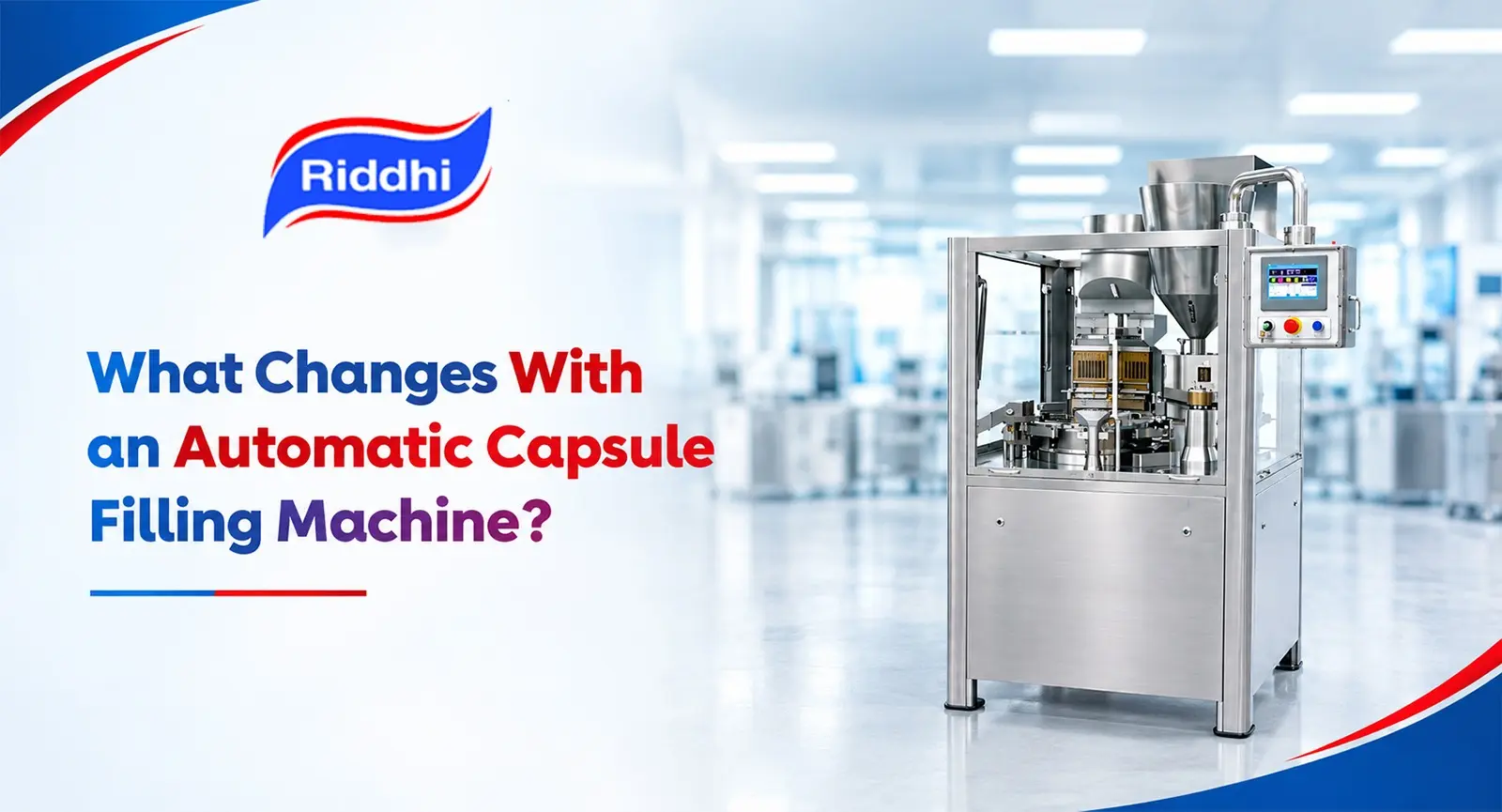
What Changes With an Automatic Capsule Filling Machine?
Top Benefits of Using an Automatic Capsule Filling Machine

Once you’re past a certain volume, this stops being about convenience and starts affecting your margins directly. Things that are affected with this machine are:

  • Fill weight stops drifting: Manual filling relies on a person staying just as precise on capsule number 3,000 as they were on capsule 30. That’s an unreasonable ask, and it’s not anyone’s fault when accuracy slips late in a shift. Automatic dosing doesn’t get tired, so fill weight stays within tolerance from the first capsule to the last.
  • You need fewer hands on the line: Standing at a manual filler for a full shift is repetitive, physically draining work, and it ties up people who could be doing quality checks or packaging instead. Cutting down on that labour requirement is often where an automatic machine pays for itself fastest, sometimes faster than buyers expect.
  • Less powder ends up wasted: Fine or sticky powders are messy on manual and semi-automatic lines, sticking to surfaces or spilling during transfer. Automatic machines use enclosed dosing stations with tighter tolerances, so more of your active ingredient ends up where it’s supposed to, inside the capsule.
  • Audits get a lot less stressful. Most automatic capsule filling machines log fill weight trends, speed, and rejection data automatically. When an inspector asks how you’re tracking consistency, pulling up that data is a far better answer than flipping through a manual logbook and hoping the numbers add up.

The Output Numbers, Side by Side

Machine Type Typical Output Best Suited For
Manual Capsule Filling Machine 2,000 – 4,000 capsules/hour R&D, trials, very small batches
Semi-Automatic Capsule Filling Machine 10,000 – 30,000 capsules/hour Growing brands, mid-scale runs
Automatic Capsule Filling Machine 25,000 – 450,000+ capsules/hour Commercial, high-volume production
If you’re filling a few thousand capsules a week, none of this changes much for you, and a manual machine is probably still the smarter buy. But once weekly volume starts creeping into the hundreds of thousands, the hidden cost of manual labour and rework usually outpaces what the machine would have cost you over a year or two.

Before You Switch to Automatic, Check These

The output number on a brochure rarely tells the whole story, so it’s worth digging into a few specifics before you commit. Before buying an automatic capsule filling machine, you need to make sure you have checked the following things:
  • Test it on your own powder, not a sample batch. A supplier’s demo often runs a free-flowing powder that fills beautifully. Your formulation might be finer, oilier, or more prone to clumping, and that alone can pull the real output well below the number on the spec sheet.
  • Time the changeover, not just the fill speed. A machine that fills fast but takes time to switch from a size 1 to a size 00 capsule is losing you production time somewhere else. Ask for the changeover duration on the model you’re considering, not the “typical” figure in a brochure.
  • Get the validation paperwork in writing before you sign. GMP compliance, IQ/OQ/PQ documentation, and material certificates should be available and current, not promised for later. If a supplier is vague about this, treat it as a warning sign, not a small detail.
Getting these answers before the purchase order goes out saves you from finding them out the hard way, usually mid-production.

Mistakes First-Time Buyers Keep Making While Buying a Capsule Filling Machine

A handful of the same errors show up again and again with new buyers, and most of them are avoidable with a bit more homework upfront. As a first-time buyer, these are the mistakes which one can make:
  • Chasing the highest output number. A machine rated for 100,000 capsules an hour on an ideal powder can run noticeably slower. The rated maximum is a ceiling, not a guarantee.
  • Never run a changeover trial. Buyers get so focused on top speed that they forget to ask how long it takes to switch capsule sizes or formulations, which is often what limits the daily output on a multi-product line.
  • Treating maintenance as an afterthought. Automatic capsule filling machines have far more moving parts than manual fillers, and skipping the preventive maintenance schedule tends to catch up with you at the worst possible moment, mid-shift, mid-order.
  • Ignoring after-sales support until it’s urgent. Local service access rarely comes up during the buying conversation, but it becomes the only thing that matters the day the machine stops running, and there’s no one nearby to call.
  • Not involving the operators who’ll actually run it. Buying decisions are often made by procurement or management alone, and the people who’ll be on the floor daily only see the machine after it arrives, by which point their feedback can’t shape the purchase.
These aren’t rare, one-off mistakes. They’re the same handful of issues that come up on almost every buyer’s second machine, once they’ve learned what the first purchase didn’t teach them in time.

Conclusion

The choice between manual, semi-automatic, and automatic filling is all dependent on the volume and what inconsistency is costing you today. Once production scales, an automatic capsule filling machine usually pays for itself through better accuracy, less wasted powder, and fewer hours spent on the line. At Riddhi Pharma Machinery Ltd., this is exactly the kind of decision we help manufacturers think through, matching the machine to what you’re actually producing, not just what looks impressive on paper.

FAQs

A manual machine needs an operator to complete every step by hand. An automatic machine performs orientation, filling, and closing continuously with almost no manual input, which is why the output gap between the two is so large.

An automatic filling machine can produce anywhere from about 25,000 to over 400,000 capsules, depending on the model and how the machine handles your specific powder.

Usually not right away. The investment is useful once volume is consistently high enough to justify the cost and floor space. Smaller batches are still better served by manual or semi-automatic equipment.

Yes, most of the machines can handle this, typically size 00 through 5, using changeable parts specific to each size.

Mostly, powder flow behaviour, capsule consistency, machine calibration, and whether maintenance is actually kept up with are the things that affect the accuracy of the machine.

Top Benefits of Using an Automatic Capsule Filling Machine

Riddhi Pharma Machinery Ltd.

Riddhi Pharma Machinery Ltd. has expertise in manufacturing pharmaceutical machinery. We have 28 years of experience in providing high-quality machinery solutions.


QR  Code